What the Wholeness Index measures,
and why it matters.
Most development tools measure skills or behaviours in isolation. The Wholeness Index measures the structural relationship between four domains of human formation, and uses that relationship to explain why capable people get stuck.
Most people are not underperforming.
They are structurally misaligned.
The gap between potential and output is almost always structural. It is not motivational, not skills-based, and not a performance issue.
When organisations label development problems as attitude or motivation issues, they are diagnosing the symptom. The instrument finds the structural constraint.
Development works when it targets the actual constraint. Not the most comfortable one, not the most convenient one. The actual one.
The Trapezium Model®
Developed by Sterizo Research Group, the Trapezium Model® maps four domains of human formation rooted in what we call the Ginosko–Sterizo® (Know–Be–Do) framework. When these four domains are aligned, knowledge develops into strength, and strength translates into purposeful action.
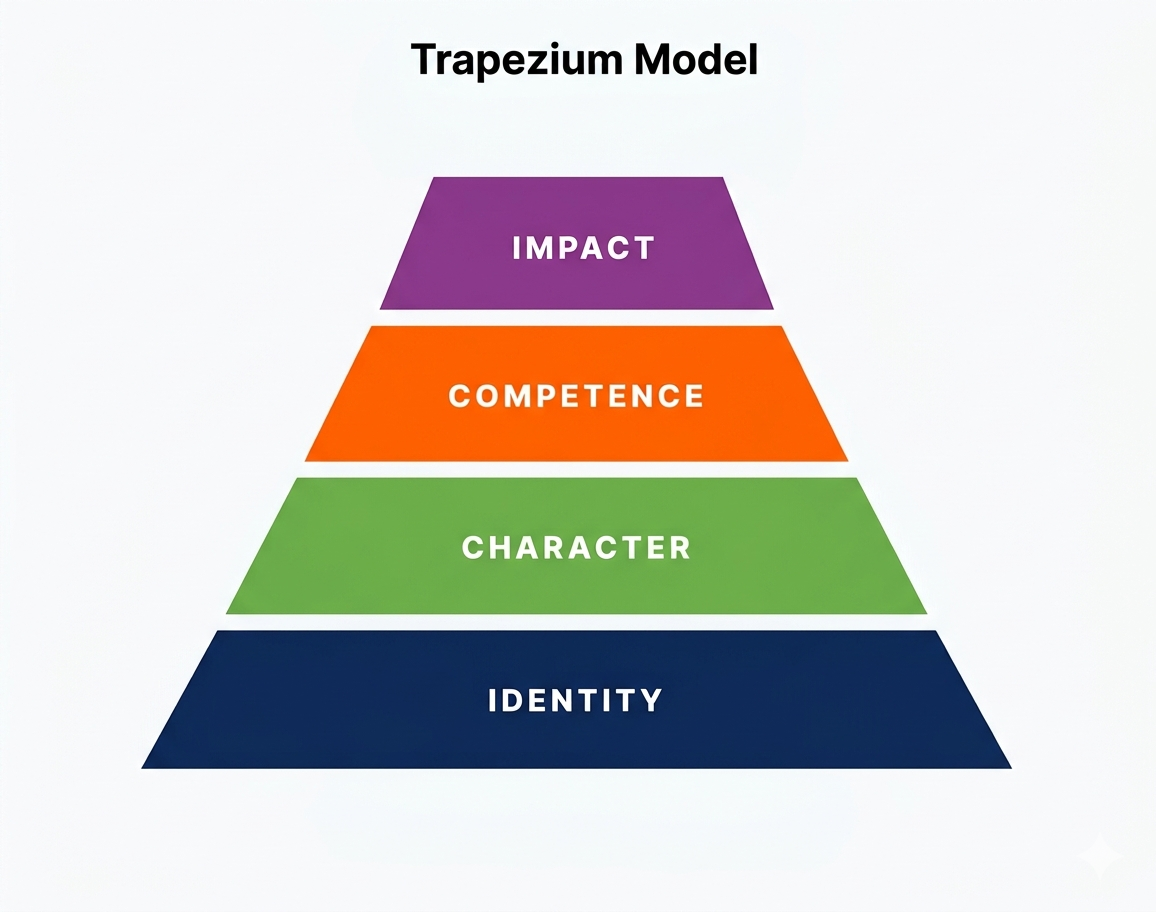
The foundation. How clearly you understand who you are: your values, purpose, worldview, and the unique contribution you are here to make. Everything else builds from self-knowledge. Without a stable Identity, even strong character and competence lack direction.
The sides of the structure. Character is the daily discipline, courage, and consistency that translates knowing into doing. It is not personality. It is the practised strength that holds the structure together under pressure.
The parallel strength alongside Character. Competence is your developed skills, technical and interpersonal capability, and the confidence to deploy them under real-world conditions. Skills without character are fragile. Character without skills is limited.
The top of the structure: the outcome. Impact is the tangible difference you make: recognition, influence, results, and the contribution that outlasts your direct involvement. It is where your inner formation becomes outer reality.
Three numbers. One complete picture.
The full 88-item assessment produces three formation indices. Together they form the Composite Formation Score: the single most useful number for understanding where you are in your development and what is limiting you.
Every score moves toward 1, toward wholeness.
The word “integrity” comes from the Latin word integer, meaning whole, complete, undivided. A person of integrity is not just someone with good values. They are someone whose identity, character, competence, and impact all point in the same direction. Nothing is pulling against anything else.
That is what the Wholeness Index measures. Every score runs from 0 to 1. A score of 1 does not mean perfect. It means integrated. It means the four parts of your formation are working together rather than against each other.
Most people sit somewhere between 0.4 and 0.8. The number tells you how integrated your formation is right now. The direction tells you what you are building toward.
How fully developed you are across all four domains combined. A high Formation Score means your identity, character, competence, and impact are all meaningfully developed. It is the single number that summarises your overall developmental state.
How well your four domains balance and support each other. High alignment means your identity and impact are proportional, and your character and competence reinforce each other. Misalignment is why capable people feel stuck: the domains are working against each other rather than together.
Whether your domains structurally reinforce each other. The Trapezium holds together when Identity and Impact are in proportion, and when Character and Competence work in parallel. Low structural integrity means one domain is undermining the others, even if individual scores look reasonable.
The three indices combine multiplicatively. A high score in one index with low scores in the others produces a lower composite. The instrument rewards coherence and structural alignment, not just raw development in any single area.
Five developmental patterns.
The score pattern across your four domains classifies you into one of five developmental archetypes. Each has a distinct constraint, a distinct development path, and a distinct set of first moves.
Built on established developmental science. Extended for practical use.
The Trapezium Model® synthesises two bodies of work (J. Robert Clinton's Leadership Emergence Theory and Erik Erikson's stages of psychosocial development) into an applied, measurable framework for professional formation. Sterizo's contribution is not to replace these theories but to operationalise them.
The Wholeness Index does not claim to replicate Clinton's emergence theory or Erikson's developmental stages as standalone instruments. It draws on both as theoretical foundations and departs from both through operationalisation, making formation measurable, iterative, and applicable to professional contexts across industries and cultures.
The research and insight engine of Pathfinder Educational Limited.
Focused on advancing how humans develop the skills, mindsets, and agency required to thrive in a rapidly changing world of work. Our work sits at the convergence of education, employability, behavioural science, and labour market intelligence.
We investigate the intersection of metacognition, metaskills, and human agency, exploring how individuals learn how to learn, make decisions, and translate potential into meaningful economic and social outcomes.
At the core of our research is a belief that underemployment is not merely an economic issue, but a developmental one. We examine how gaps in self-awareness, identity formation, and transferable skills contribute to constrained life trajectories, and how these can be systematically addressed.
How individuals process, reflect, and adapt their learning to build durable competence.
Capabilities such as self-regulation, adaptability, communication, and problem-solving as drivers of autonomy and life outcomes.
Applying frameworks such as O*NET and RIASEC to map skills, interests, and career pathways in practical, accessible ways.
Structural and behavioural drivers of underemployment, particularly among young people, migrants, and underserved populations.
Operationalising models such as Ginoskō–Sterizo® (Know–Be–Do) and the Trapezium Model® to quantify and track growth across identity, character, competence, and impact.
Translating insight into tools, products, and interventions, powering platforms like the Wholeness Index and EmployaLingua, and informing programme design across Pathfinder’s ecosystem.
Evidence-based frameworks and models
Practical assessment tools and indices
Data-driven insights for partners and policymakers
Embedded research within live programmes and pilots
How do we systematically develop people who can think, adapt, and act with clarity in the real world?
The research and insight engine of Pathfinder Educational Limited.
Focused on advancing how humans develop the skills, mindsets, and agency required to thrive in a rapidly changing world of work. Our work sits at the convergence of education, employability, behavioural science, and labour market intelligence.
We investigate the intersection of metacognition, metaskills, and human agency, exploring how individuals learn how to learn, make decisions, and translate potential into meaningful economic and social outcomes.
At the core of our research is a belief that underemployment is not merely an economic issue, but a developmental one. We examine how gaps in self-awareness, identity formation, and transferable skills contribute to constrained life trajectories, and how these can be systematically addressed.
How individuals process, reflect, and adapt their learning to build durable competence.
Capabilities such as self-regulation, adaptability, communication, and problem-solving as drivers of autonomy and life outcomes.
Applying frameworks such as O*NET and RIASEC to map skills, interests, and career pathways in practical, accessible ways.
Structural and behavioural drivers of underemployment, particularly among young people, migrants, and underserved populations.
Operationalising models such as Ginoskō–Sterizo® (Know–Be–Do) and the Trapezium Model® to quantify and track growth across identity, character, competence, and impact.
Translating insight into tools, products, and interventions, powering platforms like the Wholeness Index and EmployaLingua, and informing programme design across Pathfinder’s ecosystem.
Evidence-based frameworks and models
Practical assessment tools and indices
Data-driven insights for partners and policymakers
Embedded research within live programmes and pilots
How do we systematically develop people who can think, adapt, and act with clarity in the real world?
Where are you in the formation journey?
The rapid classifier takes 8 minutes and identifies your archetype. The full assessment produces your three formation indices and a sequenced development pathway.